
AMD (AMD) reported its fourth quarter earnings on Tuesday, beating expectations on the top and bottom lines and providing a better-than-anticipated Q1 outlook.
Despite the beat, AMD stock fell on the news.
AMD reported earnings per share (EPS) of $1.53 on revenue of $10.3 billion. Wall Street was expecting EPS of $1.32 on revenue of $9.6 billion, according to Bloomberg analyst consensus estimates. The company saw revenue of $7.7 billion in the same quarter last year.
AMD said Q1 revenue would come in between $9.5 billion and $10.1 billion. That’s better than the Street’s estimate of $9.4 billion.
Last week, Microsoft (MSFT) and Meta (META) reported their own earnings, sparking wildly divergent reactions from traders: Many balked at Microsoft’s increased spending and more modest growth but applauded Meta’s performance despite a massive jump in its own AI spending.
AMD’s data center revenue for the quarter came in at $5.4 billion, topping expectations of $4.97 billion.
While traders have raised consistent concerns of an AI bubble and overspending, shares of AMD and rival Nvidia (NVDA) are up significantly over the past 12 months, with AMD climbing 112% and Nvidia rising 54%.
On the PC front, AMD’s client business revenue hit $3.1 billion versus an anticipated $2.9 billion. The chip designer’s gaming business saw revenue of $843 million, compared to an expected $855 million.
AMD, like Intel (INTC), is contending with the global memory shortage, which could force PC makers to raise prices and lead to demand destruction that would cut into AMD’s PC and gaming segments.
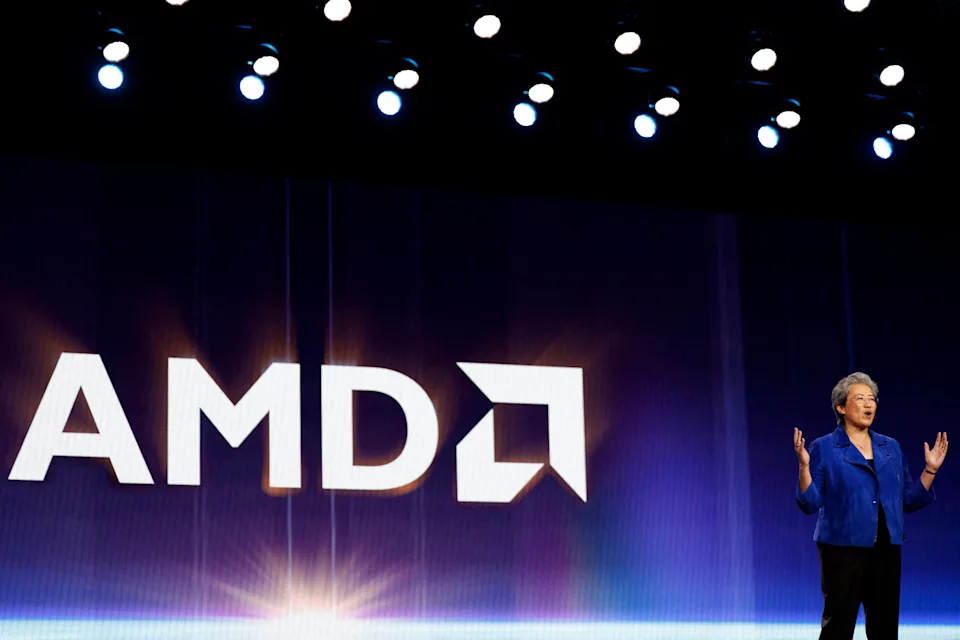
AMD’s results come roughly a month after it showed off a variety of new products during CEO Lisa Su’s keynote at CES 2026 in Las Vegas.
That includes the company’s upcoming Helios rack-scale server, which Su said is the world’s best AI rack, a clear shot at Nvidia.
Helios is designed to go head-to-head with Nvidia’s own Vera Rubin-powered NVL72 rack-scale offering. Both feature 72 GPUs and can be connected to other rack-scale systems to create a single, enormous AI computer.
AMD also provided more information about its upcoming MI500 series of GPUs, which the company claims offer up to a 1,000x increase in AI performance versus its older MI300X chips.
Su has said she believes the AI data center market will be worth some $1 trillion by 2030, giving AMD plenty of incentive to ensure it has the kind of products necessary to woo potential customers away from Nvidia.
But like Nvidia, AMD is seeing increased competition from some of its own customers, as Google (GOOGL, GOOG), Amazon (AMZN), and Microsoft (MSFT) continue to roll out more of their own customer chips in their data centers.
AMD also rolled out its new AI PC chips at the Las Vegas event, along with plans for its future in the humanoid robotics industry.
