
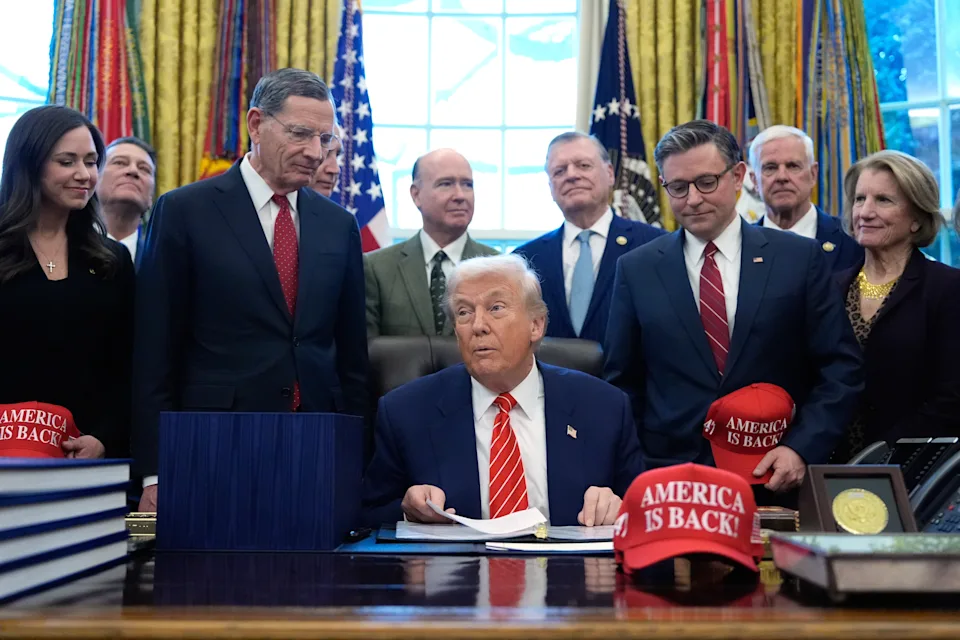
A four-day partial US government shutdown is now over after the House of Representatives gave final approval Tuesday to a funding measure and President Trump signed it into law.
“I’m thrilled to sign the consolidated appropriations act to immediately re-open the federal government,” Trump said in the Oval Office late Tuesday afternoon.
The vote in the House came down to the wire, ending with a tally of 217-214. After a day of arm-twisting, Republicans unified on a key procedural step earlier in the day, which set up the narrow bipartisan vote where 196 Republicans joined 21 Democrats to push the measure over the line and send it to White House.
Tuesday’s vote follows the Senate’s 71-29 passage of the measure last week and a White House pressure campaign that brought House Republican holdouts into the fold.
The bill contains five spending measures while delaying a final decision on funding the Department of Homeland Security until next week.
Trump’s signature means that key government functions will reopen soon — but only after a delay in the January jobs report was announced on Monday. The Job Openings and Labor Turnover survey (JOLTs) for December 2025 was also scheduled to be released on Tuesday, but was likewise delayed.
All told, funding for departments, including the Pentagon, State, Transportation, and others, will be authorized until Sept. 30 once the deal is enacted. Other areas in focus for markets — from the Federal Aviation Administration to the Internal Revenue Service — would be able to fully come back online, with minimal disruptions expected.
The politically charged funding for the Department of Homeland Security will be on a separate track, with funding extended only until Feb. 13. A fierce debate is expected over new restrictions for US Immigration and Customs Enforcement (ICE) in particular.
The movement on the bill came after President Trump himself stepped in to get his party in line.
“There can be NO changes at this time,” Trump posted on Truth Social Monday before meetings and calls that led Republican opposition to largely crumble.
Two key GOP holdouts were Anna Paulina Luna of Florida and Tim Burchett of Tennessee, who had been looking to attach a separate election bill to the package.
They backed down, they said, after a White House meeting Monday evening that gave them assurance that their bill could be addressed separately.
“Rep. Luna and myself are now willing to allow that to happen,” Burchett told reporters of the key vote to approve a rule for debate and a final vote on the bill.
Tuesday’s back-and-forth will be far from the end of the wrangling on Capitol Hill over Homeland Security. Democrats are demanding a series of changes in how immigration operations in Minneapolis and elsewhere are carried out in exchange for funding.
Some progress could be forthcoming after Homeland Security Secretary Kristi Noem announced late Monday that “every officer” in Minneapolis will soon wear a body camera.
