
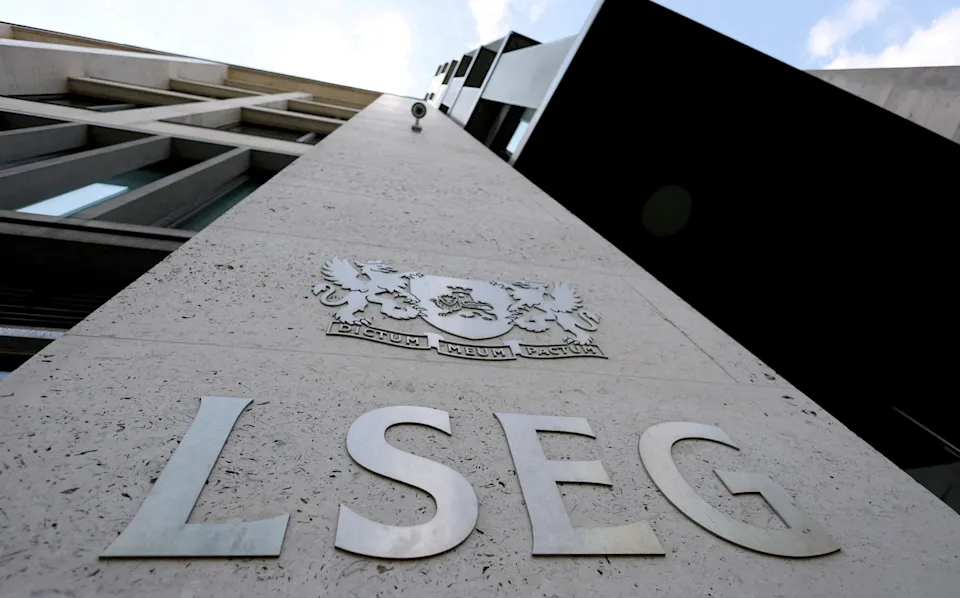
Addressing London Stock Exchange Group (LSEG) shareholders at the Butcher’s Hall last May, boss David Schwimmer took to the stage to herald the company’s big bet on data.
“We’ve transformed LSEG from a largely European, regional exchange group to a diversified, global leader in financial markets infrastructure and data services,” he boasted.
Investors hailed his foresight at the time, approving a bumper £7.8m payday for Schwimmer and sending shares to a record high.
But now, recent advances in artificial intelligence (AI) have left some investors wondering whether Schwimmer’s big bet on data might be about to unravel and be forever branded as an “AI loser”.
LSEG was one of several groups caught up in last week’s software bloodbath following the release of the new Claude AI automation tool from Anthropic, the Silicon Valley tech group.
Shares fell to their lowest level in nearly three years, shedding more than 8pc during the week, over fears that Schwimmer had made a bad bet by putting all his eggs into one basket.
In moving towards data and analytics and away from its bread and butter role running London’s stock and bond markets, there are growing fears in the market that LSEG has left itself worryingly exposed to disruption from the likes of Anthropic.
“This is a week where it’s shoot first, ask questions later,” says Michael Werner, an analyst at UBS. “The challenge here is how long this AI overhang will persist.
“So long as it’s there, the shares will not be driven by fundamentals – they will be driven by narratives.”
For many, the jewel in the crown of LSEG is the London Stock Exchange, the historic venue founded in 1698 which helped make Britain a global financial centre.
Under Schwimmer, a former Goldman Sachs banker, LSEG has been accused of relegating the British stock exchange to a mere bit part in the company’s sweeping data and analytics push.
Revenue from data and analytics surpassed £4bn in 2024, accounting for nearly half of all the company’s sales.
Its capital markets division, which includes the stock markets, made just £1.8bn or around a fifth of total income.
LSEG began beefing up on big data in 2019 by acquiring Refinitiv, the financial information and terminal business, for $27bn (£19.8bn).
Several years later, it announced a $2.8bn partnership with Microsoft to develop new data and analytic products in a bid to usurp Bloomberg and its all-encompassing terminal for financial traders.
As the threat from AI has grown, LSEG has sought to push even further into data, partnering with a raft of AI companies including Anthropic and ChatGPT.
Concerns around LSEG’s business model are not new but – like elsewhere in the software and data ecosystem – they have been building in tandem with the rapid advances in AI.
“We’re at the stage now with every iteration of GPT or Claude that comes out … it’s multiples more capable than the previous generation. The market’s thinking, ‘Oh, wait, that challenges this business model’,” Kunal Kothari, a fund manager at Aviva Investors, told Reuters.
Others have been cautious about LSEG’s over reliance on data before.
Analysts at Barclays said investors wanted to see progress on its tie-up with Microsoft and how much money LSEG might actually make from the numerous partnerships it has recently announced.
Werner, maintaining that LSEG was “guilty by association” in the recent sell-off, also said that investors “now need to see the deliverables promised by management before they give the company credit”.
While the sell-off has been brutal, some investors are sticking with the company – at least for now.
Kothari said LSEG could succeed in an AI world and there was unlikely to be a stampede towards the latest AI tools.
“We have to remember that however good the technology, it is humans that will need to decide whether to adopt it – and they need to be comfortable doing that. Typically that takes longer than you think,” he said.
Niall Gallagher, a fund manager from Jupiter, added: “I’ve lived through numerous ‘hype cycles’ before – including the 1998 to 2000 TMT bubble – and whilst technology does change the world, it doesn’t happen overnight.”
Gallagher said that LSEG’s core strength was the data it owned that wasn’t available elsewhere and which AI couldn’t replicate.
“This does not mean that every single data set or data process inside of LSEG could not be replicated more cheaply by AI, but we do think there is a strong moat,” he said.
The jury is out on whether Schwimmer’s pivot to data will bear fruit and if the company’s share price will again hit the heady heights of last year.
However, there are concerns LSEG will struggle to escape the perception that it has found itself on the wrong side of the AI boom.
“This situation has become slightly self-fulfilling because LSEG achieved this branding as an AI loser,” said Ben Bathurst, an analyst at RBC Capital.
“What we find is that in the vast majority of our conversations with participants in the market, with investors or prospective investors in LSEG, it’s widely understood that the sell-off is overdone.
“The issue is, it’s very hard to disprove some of these arguments in the short term because we’re talking about something that’s quite long-term in nature.”
