
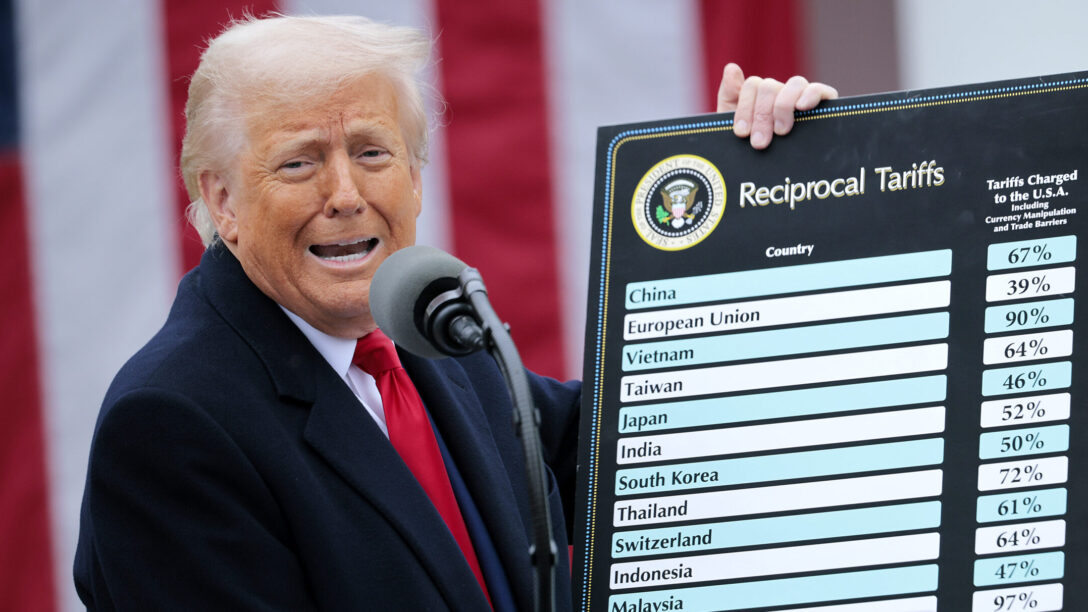
President Donald Trump did himself no favors Wednesday night when he used public calls for retribution to strong-arm most House Republicans into backing his tariff agenda despite widespread voter discontent over the cost of living.
Six ultimately defied him, voting with Democrats to pass legislation aimed at ending the White House’s duties on Canada. But for many of the 210 Republicans who stuck with Trump, the vote could haunt them in a midterm election focused squarely on affordability.
The tariffs have emerged as deeply unpopular with voters — and their support for duties seen as contributing to rising prices for consumers could erode their chances for reelection.
More politically risky votes on tariffs are ahead. The House is expected to vote as soon as this month on Trump’s duties on Brazil and Mexico, as well as his global emergency tariffs. Senate Majority Leader John Thune said he expects his chamber to vote on the Canada tariff resolution.
Trump’s defeat on tariffs in the House underscored his weakening hand over a Republican Congress he solidly controlled for most of this first year in office.
The snub comes as the president is retreating from his immigration enforcement surge in Minnesota amid public backlash and his administration is fighting fierce criticism from his own party that it isn’t doing enough to disclose Justice Department files on Jeffrey Epstein’s sex trafficking operation.
House Speaker Mike Johnson had fought for most of the past year to avoid this week’s public reproach of the president’s tariffs. Republican leadership blocked the chamber from bringing tariff-related legislation to the floor in hopes they could wait for the Supreme Court to decide whether Trump’s use of the duties was legal.
But dissident Republicans this week finally refused to go along with further delay.
The stakes ahead of the November midterm elections are high. Republicans are grappling to maintain power of both chambers, while Democrats are showing early signs of success in elections across the country. For instance, Miami voters elected a Democratic mayor for the first time in three decades, a deeply-red Texas state senate seat swung 31-points to the left and an up-for-grabs New Jersey gubernatorial race turned blue.
A Democratic-led House would water down Trump’s executive power. It would also increase oversight investigations into his administration and even spur a third impeachment vote, though slim chance the Senate would back removing him from office.
Democrats are campaigning on the increased cost of living, presenting the duties as bad for voters’ wallets. Nearly 90% of the economic burden from tariffs falls on US firms and consumers, according to a report released Thursday by the Federal Reserve Bank of New York. The nonpartisan Congressional Budget Office made a similar finding.
Democratic Congressional Campaign Committee spokesperson Justin Chermol previewed the line of attack his party plans against Republican House members who voted to sustain the president’s tariffs.
“Fearing retribution from their wildly unpopular leader who is tanking the US economy in real-time, vulnerable House Republicans chose party loyalty over affordability,” Chermol said. “Their vote to continue Trump’s reckless tariffs proves they have no plan to address rising costs.”
Recent tariff votes in both the House and Senate have put hundreds of Republican lawmakers on the record as supporting Trump’s duties, even as the tariffs have ruffled the feathers of some of their constituents.
The six Republicans who broke with Trump on the tariffs defied a public threat of retribution as the House vote was going on.
“Any Republican, in the House or the Senate, that votes against TARIFFS will seriously suffer the consequences come Election time, and that includes Primaries!” Trump said in a Truth Social post.
The stance directly contradicts the approach of key party leaders. Just this week, Thune said that the party was “all in” on trying to reelect Maine Senator Susan Collins, who last year not only voted against Trump’s Canada tariffs but also duties he imposed on Brazil and his global tariffs.
The nonpartisan Cook Political Report shifted her race to a toss-up from lean Republican in October, underscoring her vulnerable position going into November.
Several Republicans said they voted against the tariffs because of concerns from people in their district. Representative Brian Fitzpatrick, a moderate Republican who represents southeastern Pennsylvania, pointed to the Canada duties as particularly harmful for his district. He added that vulnerable members need to just focus on what matters to their constituency.
“I’m always gonna stay with my district, and I’m back home a lot, and I talk to a lot of people, and I heed their feedback,” Fitzpatrick said.
Along with Fitzpatrick, Republicans Thomas Massie of Kentucky, Don Bacon of Nebraska, Kevin Kiley of California, Jeff Hurd of Colorado and Dan Newhouse of Washington State broke with their party on the House tariff vote.
Fitzpatrick, Hurd and Kiley are among the more vulnerable Republicans who are up for reelection this year. Bacon and Newhouse said they will not seek reelection.
Others in toss-up districts who voted to support the duties are already being targeted by Democrats. In Iowa, Republicans Zach Nunn and Mariannette Miller-Meeks hold precarious positions. Miller-Meeks squeaked by her Democratic opponent during her last election in a district which Trump carried by eight points. Plus, farmers in the region are not happy with the president’s trade agenda, pointing to the retaliatory actions put on their soybean crops.
Miller-Meeks said in a statement that she wouldn’t “play along with the Democrats political stunts which seek to undermine our negotiating strength as a nation, and our President.”
A spokesperson for Nunn said in a statement the Republican congressman “is committed to giving Iowa farmers a fair shot, not asking hardworking Iowans to subsidize foreign industries through one-sided trade policies.”
House Majority Leader Steve Scalise predicted Democrats wouldn’t be able to capitalize on vulnerable Republicans’ votes in favor of tariffs and said he was confident the opposition party wouldn’t prevail in the midterms.
“The only centerpiece of their campaign is fighting anything that Donald Trump is for in and trying to hurt this country’s growth,” he said.
