
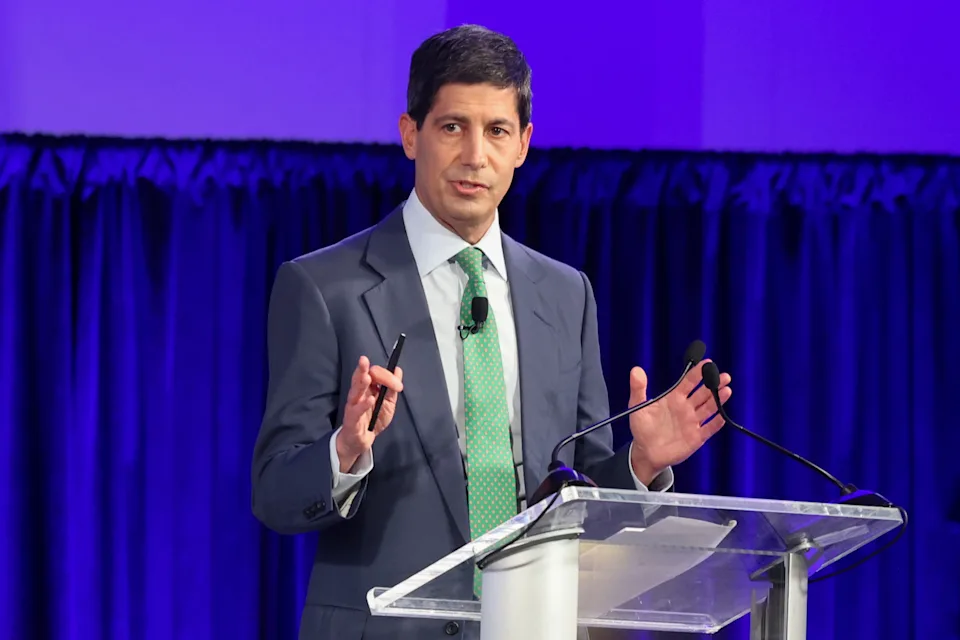
Kevin Warsh is still months away from taking the helm at the Federal Reserve, but his ability to deliver the interest-rate cuts President Donald Trump expects is facing hurdles as the US economy, and his future colleagues, tilt in the opposite direction.
Most Fed officials see no compelling reason to rush additional rate cuts, given inflation is still elevated and the labor market seems to be stabilizing. The biggest surge in oil prices in four years, stemming from renewed conflict in the Middle East, might only add to their reluctance.
Several policymakers have also voiced skepticism over the ideas underpinning Warsh’s vision for lower rates, which centers on the promise that a technology revolution is about to deliver a low-inflation economic boom, and on his pledge to downsize the Fed’s balance sheet.
This is all happening even before Warsh has been formally nominated, and while his confirmation in the Senate faces opposition from Republicans angered by a Department of Justice investigation into the Fed’s current leader, Jerome Powell, whose term as chair ends in May.
Even if that’s resolved, the dynamic suggests Warsh could face heavy resistance should he push for steep, immediate cuts, setting up a potential flash point with the White House. It may also mean Warsh will struggle to fulfill a key part of the Fed chair’s job: advancing an economic argument that persuades colleagues and drives consensus among them.
“If Chair Warsh wanted to have a sequence of cuts — four rate cuts over the second half of the year or something like that — unless we’re surprised by the data, I just don’t think he’ll have the votes for that,” said William English, a professor at the Yale School of Management and a former Fed division director. “The outlook is one where that would not be appropriate policy.”
Warsh, contacted through the Hoover Institution where he is a visiting fellow, didn’t respond to a request for comment.
‘Show-Me Stage’
After lowering rates at three consecutive meetings to close out 2025, Fed policymakers held steady in January, citing improvements in the labor market and worries about sticky inflation that ended last year almost a percentage point above their 2% target.
Bolstered by a subsequent January jobs report that was better than expected, most policymakers have endorsed the idea that the labor market is stabilizing. A few, like Cleveland Fed President Beth Hammack — a voter on rate decisions this year — said they expect rates to remain on hold for “some time.”
Even Governor Christopher Waller, who called for a quarter-point cut in January, has acknowledged the possibility that an improving labor market might warrant another hold when officials meet March 17-18.

Several officials have also considered the possibility that the Fed may need to hike rates should inflation stay above target, according to the minutes of the January meeting.
Amid early fallout from the US-Israeli war on Iran, which saw oil prices surge by nearly 20%, traders on Tuesday pared their bets officials will deliver more than one quarter-percentage-point cut this year. New York Fed President John Williams said the impact on inflation will hinge on how long oil prices remain elevated.
The Fed may yet find itself in a position later this year where inflation eases and the labor market holds up, paving the way for “good news” cuts on Warsh’s watch, said Claudia Sahm, chief economist at New Century Advisors and a former Fed economist. But for now, she added, officials are in a “show-me stage,” waiting for inflation progress.
AI Skepticism
While most of the data doesn’t point to a cut, Warsh has signaled nonetheless that larger, structural shifts in the US economy could justify lowering rates. Pointing to the surge in artificial intelligence, Warsh has drawn parallels to the 1990s internet boom, a period that saw soaring productivity that for a time helped hold down inflation and rates.
Productivity gains are crucial because labor costs are the biggest expense for many businesses. So when firms can use technology and equipment to increase output, that drives economic growth without generating wage-driven inflation.
“AI will be a significant disinflationary force, increasing productivity and bolstering American competitiveness,” Warsh wrote in a Wall Street Journal opinion piece in November.
And recently, labor productivity has indeed soared. Over 50 years, the annualized rate of growth for nonfarm employee output per hour in any given quarter has averaged 1.9%. Over the last 10 quarters, it’s averaged 2.7% and in the third quarter of 2025 it hit 4.9%, according to the Bureau of Labor Statistics.

But in the weeks since Trump announced Warsh as his Fed pick, multiple Fed officials have made clear they remain unconvinced that the economy is experiencing the same kind of conditions that allowed then-Fed Chair Alan Greenspan to run the economy hot in the 1990s.
The skepticism goes like this: It’s too early to know that AI is driving the current pickup in productivity, and even if it is, the sheer scale of AI investment may mean interest rates need to be higher, at least in the near term. Alternative theories behind the productivity jump include investments in other labor-saving technology and a burst in new-business formation.
“I don’t think I’m alone in this, but the growth and productivity we’ve seen over the last year or two isn’t from AI,” Waller, who until Warsh’s selection had been in contention for the Fed’s top job, said in a panel discussion on Feb. 23. “I don’t think any of us believe that that’s the big driver.”
Other Fed officials, including Governors Michael Barr and Lisa Cook, and Vice Chair Philip Jefferson have expressed similar doubts.
Jeff Schmid, the Kansas City Fed chief, said Tuesday while he’s optimistic artificial intelligence and other burgeoning technologies will one day lead to non-inflationary growth, “we are not there yet.”
Balance Sheet Pushback
The other pillar of Warsh’s outlook — that shrinking the Fed’s $6.6 trillion balance sheet can create room for cuts — also hasn’t gained traction among policymakers or on Wall Street. The Fed’s securities holdings ballooned in part because officials judged more stimulus was needed when the central bank’s benchmark rate hit zero during the Global Financial Crisis, and again during the pandemic.
“The Fed’s bloated balance sheet, designed to support the biggest firms in a bygone crisis era, can be reduced significantly,” Warsh said in the November Wall Street Journal piece. “That largesse can be redeployed in the form of lower interest rates to support households and small and medium-size businesses.”
But while Warsh enjoys support from Treasury Secretary Scott Bessent, analysts caution the process is fraught with risk and will take time. Simply letting securities roll off could spark severe volatility in short-term funding markets as liquidity dries up — just as happened in 2019.
Analysts say the Fed could ease rules requiring banks to hold large cash reserves at the central bank, or shorten the average maturity of their Treasury holdings, but add that these steps couldn’t be done quickly and would yield limited results.
Another, more radical step would be to return to the way the Fed controlled interest rates before the financial crisis — a system that kept bank reserves at an absolute minimum but resulted in more volatility for its benchmark.
In an effort to soothe markets, Bessent has said he anticipates the Fed will move cautiously.
“I wouldn’t expect them to do anything quickly,” he said in a Fox News interview on Feb. 8. “They’ve moved to the ample-regime policy, and that does require a larger balance sheet, so I would think that they’ll probably sit back, take at least a year to decide what they want to do.”
In a sign of the debate that’s ahead, Waller was more blunt in his rejection of returning to a “scarce” reserves regime.
“You don’t want banks every night of the day digging around in the couch cushions, looking for money,” he said earlier this month. “This is massively inefficient and stupid.”
