
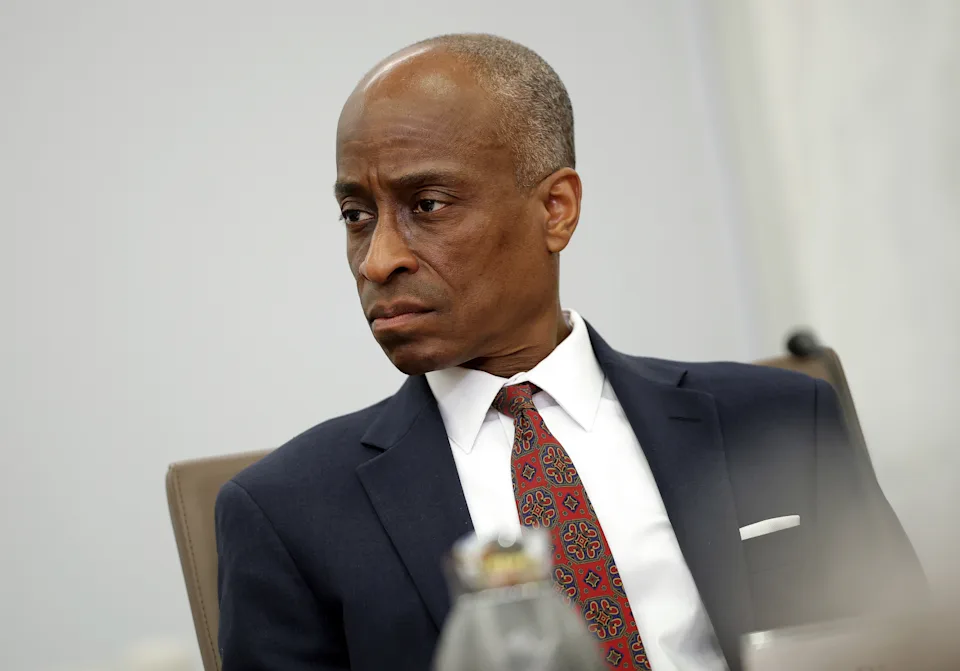
Federal Reserve Vice Chair of Supervision Philip Jefferson said Thursday evening that he expects the war in Iran will push up inflation in the near term and that interest rates are “well-positioned” to respond to a range of economic outcomes.
“At least in the short term, I expect overall inflation to move higher, reflecting a rise in energy prices stemming from the conflict in the Middle East,” Jefferson said in a speech in Dallas.
“Looking ahead, I believe that the current policy stance leaves us well-positioned to determine the extent and timing of additional adjustments to our policy rate.”
Jefferson is closely monitoring the situation in both the Middle East and global energy markets, but noted it’s still too early to say how the economy will be impacted. He stressed that the effects of the war in the Middle East will largely depend on how long energy prices remain elevated. He noted that a short period of disruption is unlikely to have a noticeable effect on the economy beyond a quarter or two, but that sustained higher oil prices could have material implications.
Jefferson said the increase in oil prices to date should have relatively modest effects on inflation, though consumers are seeing higher gas prices at the pump now.
He said he is monitoring to see if these higher costs become embedded in prices throughout the economy.
The longer energy prices remain elevated, the more households will need to confront trade-offs. Families who depend on oil and gas to commute to jobs and school and to heat their homes may need to pull back on more discretionary forms of spending, Jefferson warned. That could potentially result in lower spending at restaurants or retailers, as well as households carrying higher levels of debt.
He noted that ongoing uncertainty over tariff policy and the recent jump in energy prices complicate the economic picture for the Fed when it comes to both inflation and maintaining maximum employment.
Before the conflict in Iran began, inflation had remained above the Fed’s 2% goal for five years, with progress on bringing down inflation looking as though it had stalled over the past year. Jefferson chalks that up mainly to tariffs, but also said inflation on services excluding housing has largely moved sideways over the past year. However, counteracting that are strong productivity growth and deregulation.
The job market, Jefferson said, is “roughly in balance,” but risks are “skewed to the downside.” He noted that he expects the unemployment rate to remain around its current level of 4.4% this year, but that overall job gains are likely to remain low. He said he’s attentive to the pace and composition of job creation as he assesses the health of the labor market.
Still, he sees the economy expanding at a similar or slightly faster rate than last year, though he noted uncertainty around his outlook is high.
“Uncertainty about the economy is elevated, and the rise in energy prices and the conflict in the Middle East add to that uncertainty. I continue, however, to see our current policy stance as appropriately positioned to allow us to assess how the economy evolves.”
Speaking separately in Washington, D.C., Thursday night, Fed governor Michael Barr also noted that recent shocks from the oil spike to tariffs have complicated the Fed’s efforts to bring inflation back down to 2%.
Like Jefferson, Barr noted that if the conflict were to end soon, it’s possible the effects on inflation and the economy could be limited, but if it continues, it could have broader effects on both.
Barr worries that inflation has remained above the Fed’s target for five years now and is concerned that another spike in oil prices, if sustained, could increase longer-term inflation expectations.
“Given the considerable uncertainty about the potential effects of developments in the Middle East on our economy, as well as the other factors I mentioned, it makes sense to take some time to assess conditions,” said Barr. “Our current policy stance puts us in a good place to hold steady.”
