
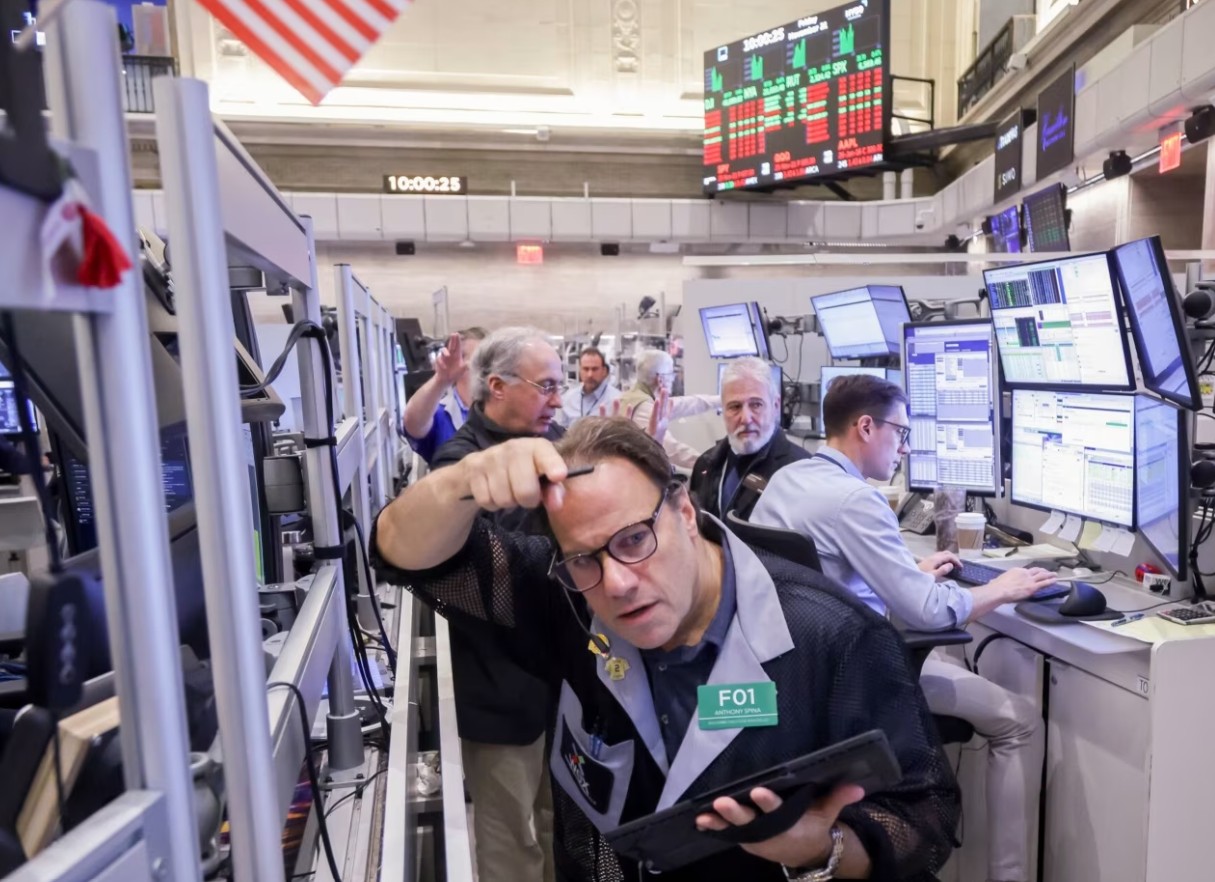
Five weeks of war with Iran have wiped trillions off global stocks, pushed oil past $100 and kept it there and repriced wagers on interest rates and inflation.
This week was supposed to bring clarity on when, and how, all that disruption would end. Investors are still waiting.
President Donald Trump’s primetime address on Wednesday signaled more attacks and imminent peace simultaneously, offered no framework for reopening the Strait of Hormuz and effectively told allies to figure it out themselves. By Thursday morning, stocks had plunged — then recovered almost entirely on a single headline about Iran drafting a shipping protocol with Oman. Not a ceasefire. Not a reopening. A monitoring framework. That a market can swing 1.5% on that little tells you where investor psychology stands.
On Tuesday, the S&P 500 had surged 2.9% for its best day since May on hopes the conflict was winding down. That arc — relief, disappointment, panic, relief — is the pattern that has defined this war for markets. The benchmark still ended the week up more than 3%, its best showing since November. But the rally was built on headlines, not resolution.
Brent crude, which has gained roughly 50% since the conflict began — the biggest monthly surge in decades — jumped back near $110 at the end of the holiday-shortened week. Wells Fargo Securities LLC cut its year-end S&P 500 target. And the International Energy Agency warned that April will be far worse for oil supply than March.
All that is the backdrop against which money managers are now making real decisions. David Royal, chief financial and investment officer at Minneapolis-based Thrivent with $212 billion in assets, watched the speech from a New York hotel room expecting a defining moment.
“There’s not a clear end game for market disruption,” he said. He’s been quietly moderating growth-stock exposure in favor of value without panicking. He’s now watching beaten-up blue chips for a chance to buy in the coming weeks. “When it’s least comfortable to add equity is when you should be doing that,” he said. “Markets bottom when uncertainty is at its maximum.”
Others aren’t waiting around. Florian Ielpo, head of macro at Lombard Odier Investment Managers, has already scaled his portfolio back to what he calls cruise mode — 40% in risky assets, the rest in bonds, commodities and volatility hedges. “I don’t buy the argument of the value of staying invested,” he said. “Sometimes there is a shock and you need to be disinvested.”
He compared the moment to turbulence on a flight — strap in and wait it out — but said oil between $100 and $120 creates pressure that becomes overwhelming if it persists. Ielpo is now publishing daily notes in response to client demand and says outlook calls are drawing roughly double the usual attendance. “There’s a strong need for clarity,” he said. “You hear the word ‘uncertain’ a lot.”
Rushabh Amin at Allspring Global Investments argues the shock is transmitting through rates and the dollar rather than hitting equities head-on — and that repricing is what’s moving everything else. His highest-conviction trade is long dollar, which he considers contrarian. David Lebovitz at JPMorgan Asset Management has a bear case of oil averaging $125 for the full year, dragging growth by a full percentage point. His high-conviction idea: own US tech, which he sees as more insulated from geopolitical disruption than almost anything else. He’s short Europe.
In debt investing, the picture is more measured even if private market risks lurk under the surface. Matt Wrzesniewsky, head of fixed income client portfolio management at Vanguard Group, said credit markets have repriced but not broken down — a distinction he attributes to the economy’s underlying strength. Yields remain high enough to keep attracting buyers, and he sees the best value in medium-term investment-grade corporate bonds. “For those considering a move to cash, we would urge caution,” he said.
All of it is playing out against an economy that, by most measures, is still growing. Retail sales are strong. Manufacturing is expanding. Consumption is holding up. Thrivent’s Royal notes the US uses a fraction of the oil per unit of GDP it did in the 1970s and is far more energy independent — the structural case for resilience is real. But rising gas prices are eroding the tailwind from tax refunds, and that pain skews toward consumers who can least absorb it. “This would exacerbate the K-shaped economy,” he said. “There is a growing disconnect between how the economy performs and how it feels.”
The question that has replaced “when does the fighting stop” is harder: how long does the economic damage last after it does? If oil stays elevated long enough, even the bulls concede it eventually destroys demand.
BCA Research tracks an index of economic and political pressure on the White House — factoring in stock returns, Treasury yields, mortgage rates, gasoline prices and presidential approval — designed to gauge when the administration is likely to reverse course. It’s flashing right now. “We’ve already incurred high economic and political costs for the US according to the index,” said BCA’s Felix-Antoine Vezina-Poirier. “The pattern has been for President Trump to open negotiations with massive demands, and eventually scaling back to focus on what he really wanted and declaring victory.”
