
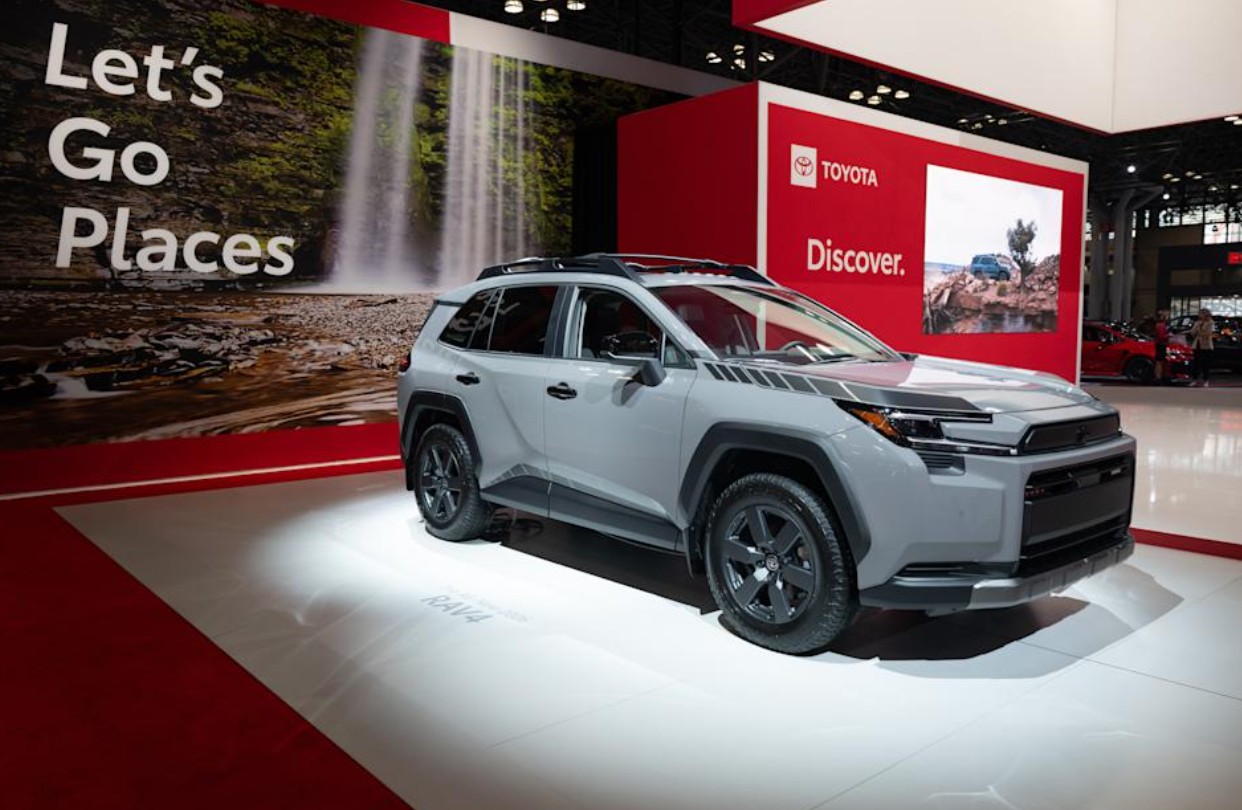
Toyota (TM) came to the New York International Auto Show riding a wave of momentum. The Japanese automaker posted one of its best US sales years ever in 2025, and 2026 is off to a decent start in Q1, easily besting big competitors like Ford (F) and GM (GM).
But the story on the show floor this week is about how the company can maintain its leadership amid higher dealership prices and rising gas prices.
That’s why it’s so interesting that Toyota is putting a lot of effort into having four EVs in its lineup by the end of the year, just as broader EV demand has shown signs of cooling.
“By the end of this year, we’re going to have four BEVs [battery electric vehicles], up from just one that we’re selling today,” said David Christ, Toyota Motor North America Group vice president and general manager, who essentially runs the North American business.
The rollout spans a range of vehicles. The compact C-HR, which Christ described as “a fun urban BEV” with strong early feedback from dealers and consumers, is just now arriving at dealerships. The bZ Woodland follows. It’s larger, more rugged, and aimed at buyers who want to bring their outdoor gear along. And later this year, Toyota will launch a fully electric Highlander, a seven-passenger SUV available only as a BEV that will also carry a “made in America” story, as it will be built in the US.
That domestic production commitment will run across several models, and it won’t come cheap.
Christ pointed to Toyota’s $13.9 billion North Carolina battery plant, a recently announced additional $10 billion in US investment, and $1 billion announced last week specifically allocated to expanding capacity in Kentucky and Indiana.
”We want to sell where we build and build where we sell. So we’re going to continue to invest in the US and manufacturing,” Christ explained.
Currently, about 85% of Toyota’s US sales are North American-made, with 55% built in the US. That has helped the company navigate the tariff environment better than some rivals. Still, models like the GR Corolla and new Tacoma are imported, and tariff costs are real.
It’s particularly painful for vehicles like the Tacoma, built in Mexico, where President Trump has placed 25% tariffs on all imports, though there are rebates for the use of US-made parts in those cars.
Toyota projects tariff costs for the fiscal year ending in March will hit $9 billion, the highest among the major automakers operating in the US.
“Tariffs are challenging. They are an additional cost for the industry, and we’re working through those,” Christ said, adding that Toyota currently offers six vehicles under $35,000. “We spent a lot of time trying to keep our cars affordable, and we’re going to continue to focus on that.”
Affordability, Christ noted, is a problem that goes well beyond sticker prices. “It’s not just the price of cars. It’s also interest rates, the cost of car insurance, gas prices. We’re very sensitive to that,” he said. The company’s response includes maintaining base-trim offerings so more buyers can access the lineup regardless of what’s happening at the macro level.
On the supply chain, Christ said Toyota has so far avoided major disruptions from the Strait of Hormuz closure, though the company monitors the situation daily and has seen its Middle East vehicle sales “massively disrupted.”
The show floor itself offered a snapshot of where Toyota’s momentum is concentrated. Front and center: the redesigned RAV4, rebuilt from the ground up with a new powertrain, new frame, and updated safety systems.
“The RAV4 is a home run,” Christ said. “It’s the No. 1 selling vehicle in the US.”
