
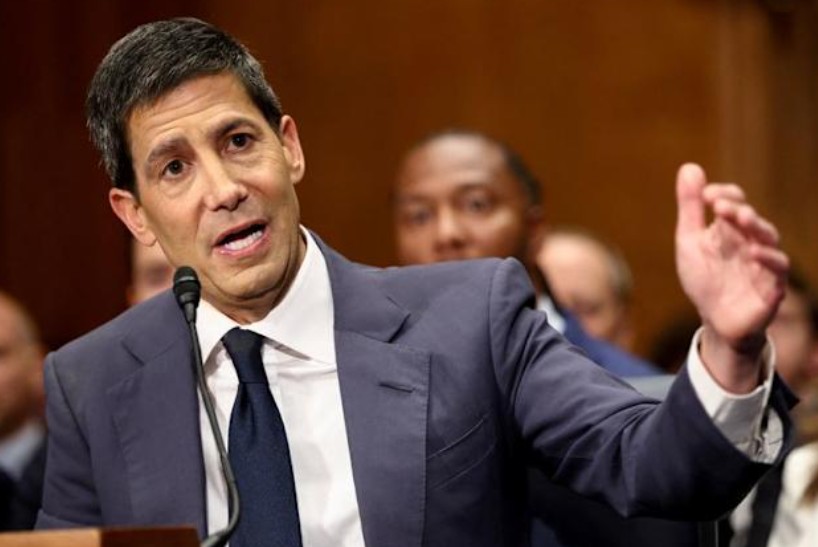
Kevin Warsh, President Trump’s nominee to lead the Federal Reserve, told lawmakers this week that inflation should be viewed through a different framework and the Fed’s own analysis of price changes needs to be reformed.
The Fed’s preferred gauge — the Personal Consumption Expenditures index — offers only a rough take on inflation, Warsh said, even as volatile food and energy prices are excluded.
Warsh favors using “trimmed averages” of inflation, he told Senate lawmakers during his confirmation hearing this week. The trimmed mean and median remove outliers. Both the Dallas Fed and the Cleveland Fed release a trimmed average inflation gauge that excludes outlier data — both high and low — to provide a clearer picture of prices.
Warsh said that the current underlying trend of inflation is “somewhat improving” and looks “quite favorable” when examining so-called trimmed measures of inflation. The Dallas Fed trimmed mean PCE is currently 2.3%, while the Cleveland Fed median PCE is 2.8%. — both lower than the latest reading of core PCE, which is at 3% and expected to increase.
“I’ve always been a fan of looking at multiple inflation measures, but not necessarily picking and choosing in a way that moves from one meeting to another or every three meetings you pick the inflation measure that gives you the story you want,” said Loretta Mester, former president of the Cleveland Fed. “But the message I took from the testimony is that he’s going to be looking at a panoply of measures.”
Mester pointed out that the way some of the trimmed inflation measures are constructed gives them a downward bias.
“I think you have to be cautious,” she said. “This seems like a particularly poor time to be going toward trimming because of the downward bias, and this is true in the CPI trimmed mean, but also the PCE trimmed mean.”
Changes in inflation factor heavily into monetary policy, influencing whether the Fed raises interest rates when inflation is running hot or lowers them to boost economic growth.
Any adjustment to the way the Fed measures inflation is sure to spark a market reaction.
“The analytical question is whether in citing these alternative metrics, Warsh is shifting the goalposts or making a reasonable economic argument,” said Krishna Guha, head of economics and global central banking for Evercore ISI. “He would not be the first Fed chair to pick metrics that suit his case. But shopping around on inflation when the generally used indicator is not behaving is risky.”
One of the first reforms Warsh said he wants to pursue would involve a broad review of data from the Bureau of Labor Statistics and private sector sources in which he’d like to “survey a billion prices” to better determine the median changes.
Warsh also reaffirmed he wants the Fed to carry a smaller balance sheet, which he acknowledged would take time to whittle down. He said if the Fed had a smaller balance sheet, interest rates could be lower and inflation more contained. Warsh said he believes interest rates are a better, broader tool for steering the economy than using the Fed’s balance sheet, which he says disproportionately helps those with financial assets.
Changes to the Fed’s balance sheet would require agreement from the Federal Open Market Committee — Warsh could not unilaterally change policy.
