
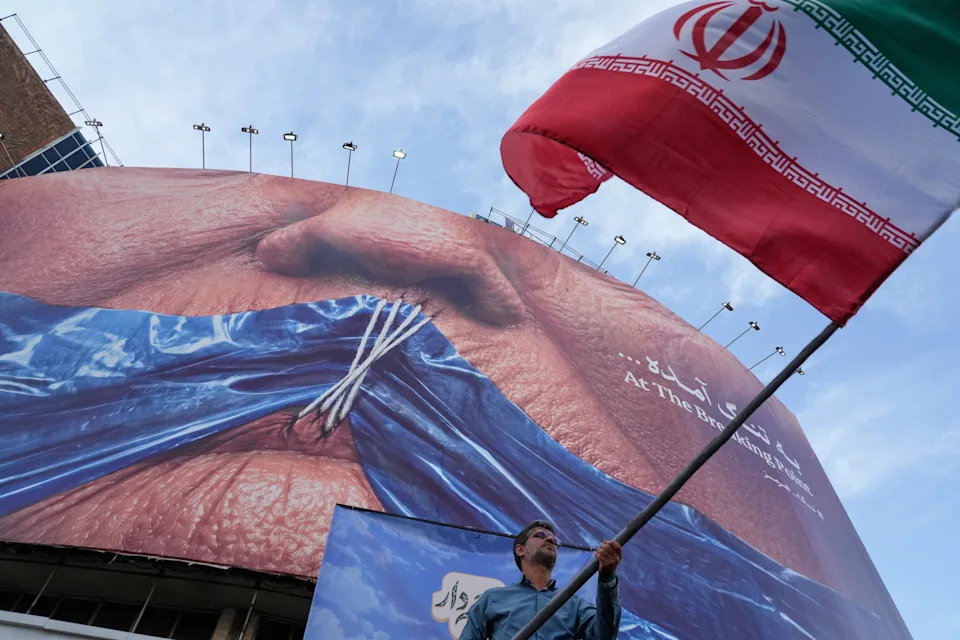
The US military began a renewed round of air strikes on Iran Wednesday evening, sending oil prices surging north after several days of escalating tensions between Washington and Tehran.
Futures on Brent crude (BZ=F), the international benchmark, gained 3.4% to cross above $96 per barrel after falling below the level on Monday. Contracts on US benchmark WTI crude (CL=F) advanced a stronger 3.8% to climb above $93 per barrel.
Prices on both contracts pulled back by roughly 1% after Fox News reported comments from President Trump that he spoke with Iranian leaders directly and the US bombing campaign would end shortly after. The US would “bomb the shit out of them” if Iran didn’t sign an agreement put forward by Washington, Fox News reported Trump saying.
The development from the Middle East sent futures on the S&P 500 (ES=F), Dow Jones Industrial Average (YM=F), and Nasdaq 100 (NQ=F) all falling to losses.
The strikes come after threats from President Trump and Secretary of Defense Pete Hegseth throughout Wednesday that the US would be resuming more severe action toward Iran after an initial round of strikes on Tuesday.
“We’re going to be attacking them, attacking them very hard,” Trump told reporters at the White House, only hours before the strikes began. “We hit them hard yesterday, and we’re going to hit them hard again today.”
The President also said on Wednesday that Iran, which he has accused of slow-walking negotiations, “has taken too long to negotiate a deal that would’ve been great for them,” adding that, “now they will pay the price.”
US Central Command confirmed it had begun “additional self-defense strikes” against “multiple targets in Iran” at 5:15 p.m. ET, shortly after 1 a.m. in Tehran. While the US has not confirmed where its strikes have so far taken place, Iranian media reported explosions near Qeshm and Kish Islands along the Strait of Hormuz, as well as near the southern cities of Bandar Abbas, Minab and Sirik, per Reuters.
Iran’s top military command said less than two hours after the US airstrikes began that the Strait of Hormuz, the world’s most critical chokepoint for global oil flows, is now completely closed, per Reuters. Iranian media, citing Iran’s Revolutionary Guard, reported that two ships had been struck while trying to make the crossing out of the Persian Gulf.
Iranian leaders had vowed on Wednesday to retaliate against any military action by the US. The news agency Tasnim, affiliated with Iran’s Revolutionary Guard Corps, reported that the Iranian military would target US-affiliated locations within the Gulf region.
“We prefer the language of diplomacy, but we speak other languages far more fluently,” parliamentary speaker Mohammad Bagher Ghalibaf wrote on social media. “Break your commitments, and we’ll switch to what we speak best. You ride the horse you saddled!”
After the initial US airstrikes on Tuesday — which the US attributed to the downing of a US Army helicopter in Omani waters — Jordan, Bahrain, and Kuwait all acknowledged attacks within their borders in the hours after the US airstrikes, per Reuters.
The escalation in conflict, which initially started on Sunday when Israel struck the Iran-funded proxy force Hezbollah in Lebanon, threaten to further destabilize what are already delicate peace negotiations between Washington and Tehran.
The renewed hostilities of the past few days mark the first serious escalation since the signing of the ceasefire agreement in early April. While the US and Iran have both said the ceasefire doesn’t include the Israeli campaign against Hezbollah, Iran has insisted any agreement must include a cessation of conflict in Lebanon.
The strikes also come after more than a dozen rounds of comments from President Trump that roll between promising aggression against Iran if the Islamic Republic doesn’t make a deal, and insisting that a peace deal is close at hand.
However, if the conflicts Wednesday night represent a serious heating up of the war in Iran, oil prices could reach as high as $150 per barrel in the near term, Jorge León, head of geopolitical analysis at Rystad Energy, said Wednesday.
After reaching a wartime high just under $120 per barrel, prices on both Brent and WTI crude have spent the past two months gradually receding to sit firmly under $100 per barrel.
A number of developments have helped keep a lid on prices for the past two months. Global inventory draws, including record levels of drawdowns from the US strategic petroleum reserve, have been key to easing pressure, as have movement of around 5 million to 7 million barrels per day of oil out of the Persian Gulf through Saudia Arabia’s pipelines. Finally, so-called “dark” ship movements and reduced imports by China have helped stabilize prices too.
However, experts warn that the global oil system is approaching operational minimum levels, where prices will be forced up until demand destruction can contain their rise.
“At this stage, it is too early to say whether the current escalation marks a full resumption of hostilities or a dangerous but still containable episode,” León said.
“What is clearer is that the probability of a near-term deal has narrowed from our prior assessment of around 40% a few weeks ago. The direction of travel is now more uncertain, and the next few days will be critical in determining whether diplomacy can reassert itself or whether the conflict moves into a more sustained escalation cycle.”
While markets have had largely muted reactions to the near-daily cycle, traders on Wednesday reacted much more forcefully to Tuesday night’s round of airstrikes, sending US equities sharply lower — and Wednesday’s conflict immediately sent futures into the red.
“Cooler heads may ultimately prevail, [but] uptick in the war would imply closer and closer to a forever war,” Robert Yawger, the director of energy futures at Mizuho Securities, said in emailed commentary.
“Hard to imagine the latest strikes increasing the odds the Iranians [are] going to hand over their nuclear fuel and dismantle their nuclear program anytime soon. Hard to imagine Americans going into Iran and digging through the rubble at Natanz and Isfahan and walking away with the enriched uranium, even if there was a deal.”
